
For many years, the reception desk was a fixed feature of corporate buildings: a physical counter, a receptionist, a telephone, a visitor logbook and a set of local procedures.
That is changing.
Organisations are increasingly spread across multiple locations. Staffing costs are rising. Companies are managing several sites. At the same time, IT and security requirements are becoming more demanding, while visitors expect a fast, professional and straightforward welcome.
Reception is therefore gradually becoming a digital business process.
However, this does not necessarily mean that human service is disappearing.
The most interesting development lies in the combination of digital reception software, visitor management, AI and reception over distance.
Since 2001, Teleportel has been developing technologies to support the digital transformation of reception services. Based in Brussels, its systems have been deployed internationally in more than 30 countries.
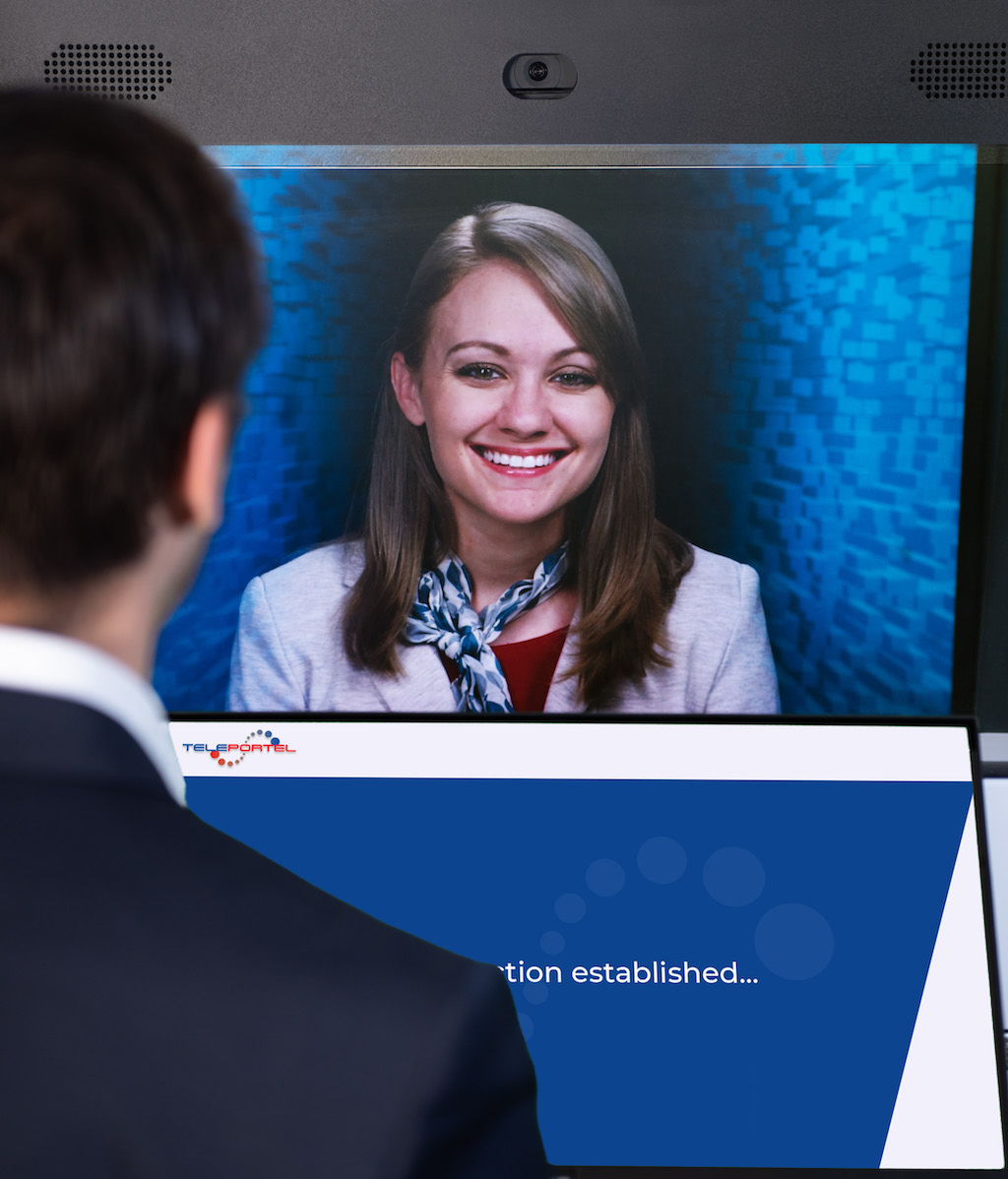
What Is Digital Reception?
Digital reception automates processes traditionally handled by a receptionist or through separate administrative procedures.
These include:
- Visitor pre-registration
- Digital visitor check-in
- Identification
- Host notifications
- Visitor badge printing
- Attendance registration
- Safety information
- Building access
- Reporting
- Visitor services
For example, a visitor can receive an invitation in advance containing practical information and a QR code. After scanning the code at the reception kiosk, the check-in process can start automatically. The host is then notified and, where applicable, a badge can be issued or access activated.
This approach can reduce waiting times and manual administrative tasks while giving organisations greater control over their visitor processes.
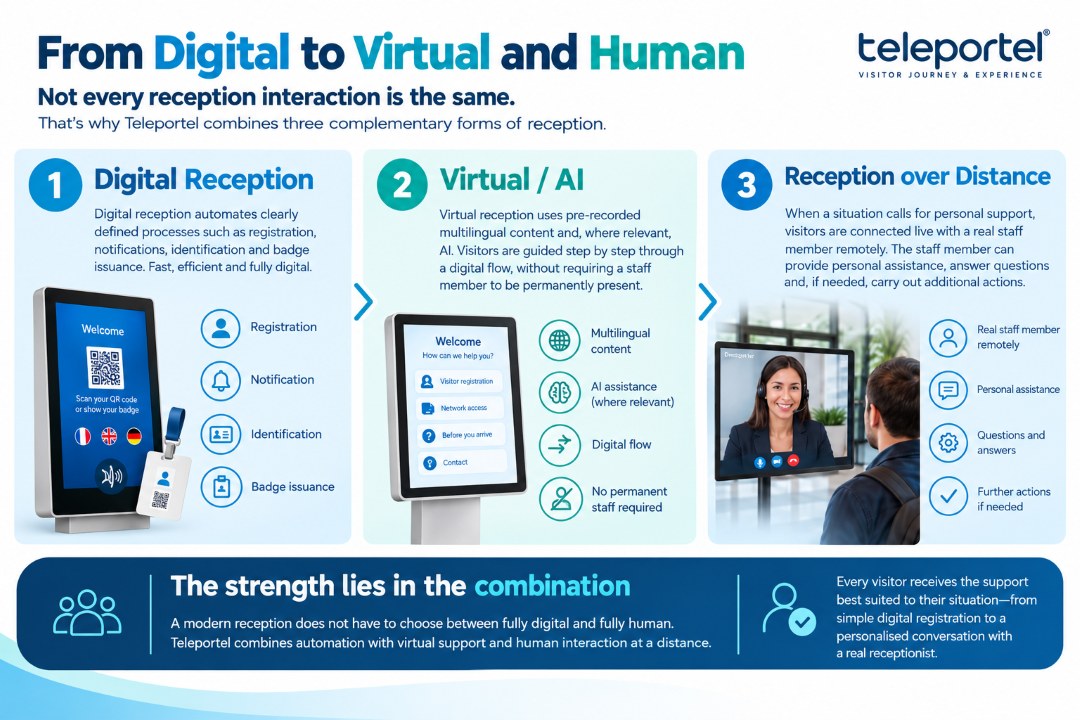
From Digital to Virtual and Human Reception
Not every interaction at reception is predictable.
That is why Teleportel distinguishes between three complementary technologies.
1. Digital Reception
Processes are handled electronically and automatically. This solution is particularly suitable for clearly defined transactions such as check-in, notifications, identification and badge issuance.
2. Virtual Reception
Virtual reception can use pre-recorded multilingual content and AI. Visitors are guided through a digital journey without requiring a staff member to intervene continuously.
3. Reception over Distance
When personalised assistance is needed, visitors communicate live with a real agent located elsewhere.
This combination avoids a major limitation of fully automated reception: not every visitor or situation can be accommodated within a predefined menu.
Reception over Distance Is More Than a Video Call
Setting up a live video connection is not particularly difficult from a technical perspective.
Organising a complete remote reception service is another matter.
The receptionist must be able not only to communicate with visitors but also to manage the entire reception process.
Depending on the configuration, this can include:
- Registering visitors
- Issuing badges
- Checking identity documents
- Sharing information
- Consulting documents
- Opening doors
- Transferring calls
- Managing visitors in a queue
- Calling in a colleague
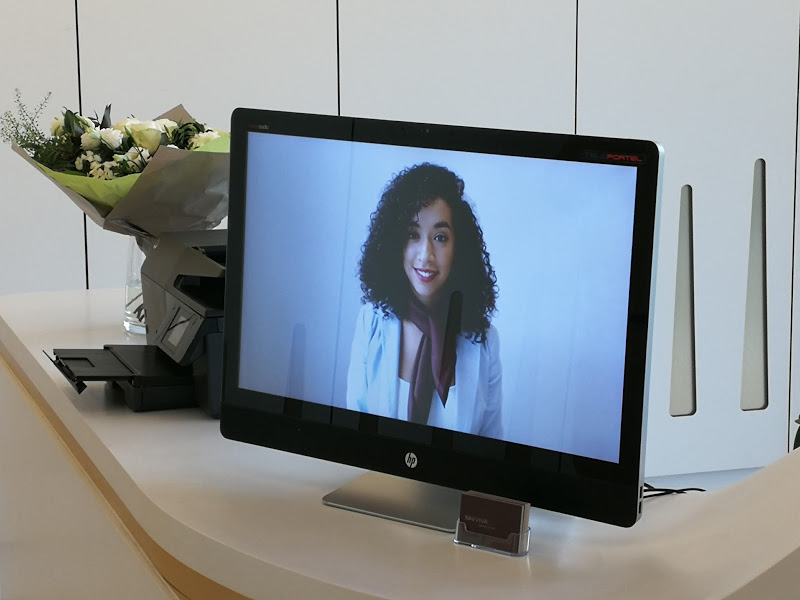
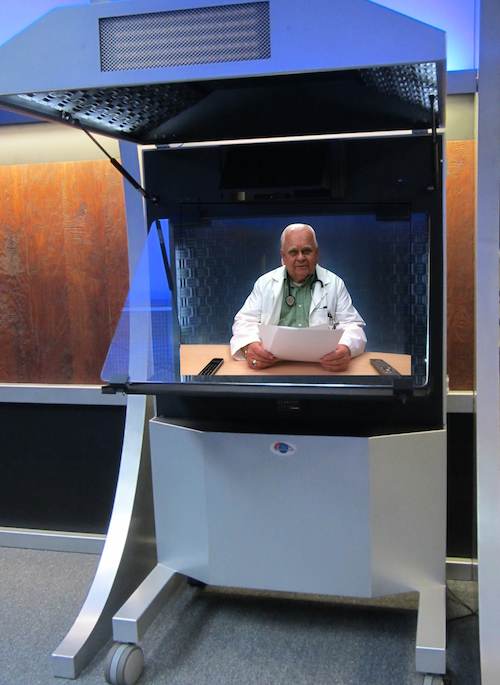
Teleportel also offers specialised workstation technology for live video communication, with solutions designed to provide natural eye contact and create a stronger sense of physical presence at a distance.
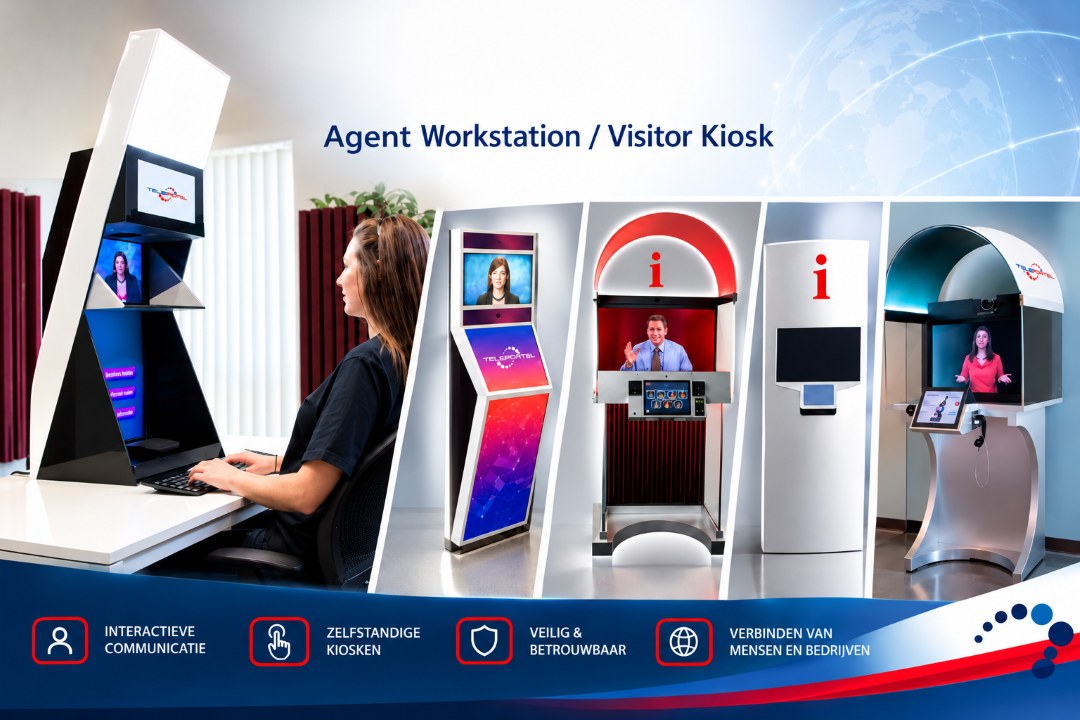
Why Multi-Site Organisations Are Rethinking Reception
A receptionist physically seated at one desk can, in principle, serve only that particular reception area.
With a digital infrastructure, this model changes.
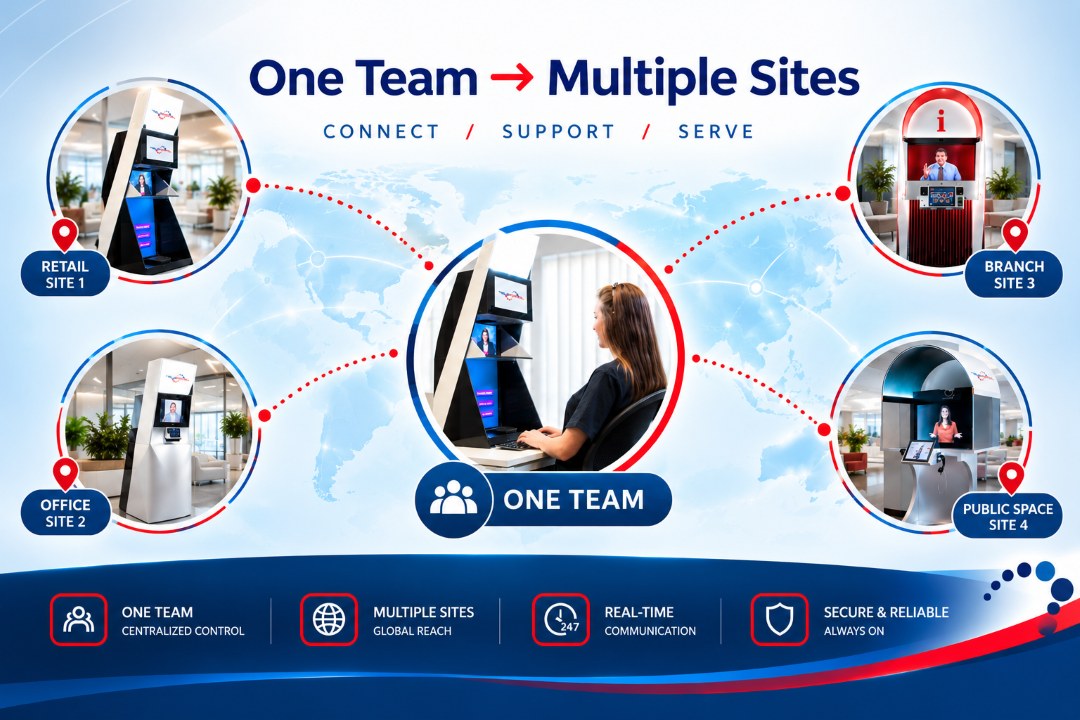
A central reception team can support multiple locations. If there are no visitors at Site A while someone needs assistance at Site B, available capacity can be allocated dynamically.
Routing software, queue management and real-time monitoring therefore become at least as important as the kiosk itself.
For Facility and Operations Managers, this means that reception capacity no longer necessarily has to be organised building by building.
This can be particularly relevant for corporate headquarters with satellite offices, multi-tenant buildings, international organisations, logistics networks and other businesses operating across multiple locations.
Visitor Management and Access Control Are Converging
Visitor registration is not an isolated reception process.
After registering, visitors often need access to a building, floor, car park, warehouse or specific area.
Integrating visitor management and access control is therefore a logical step.
A possible workflow is illustrated below.
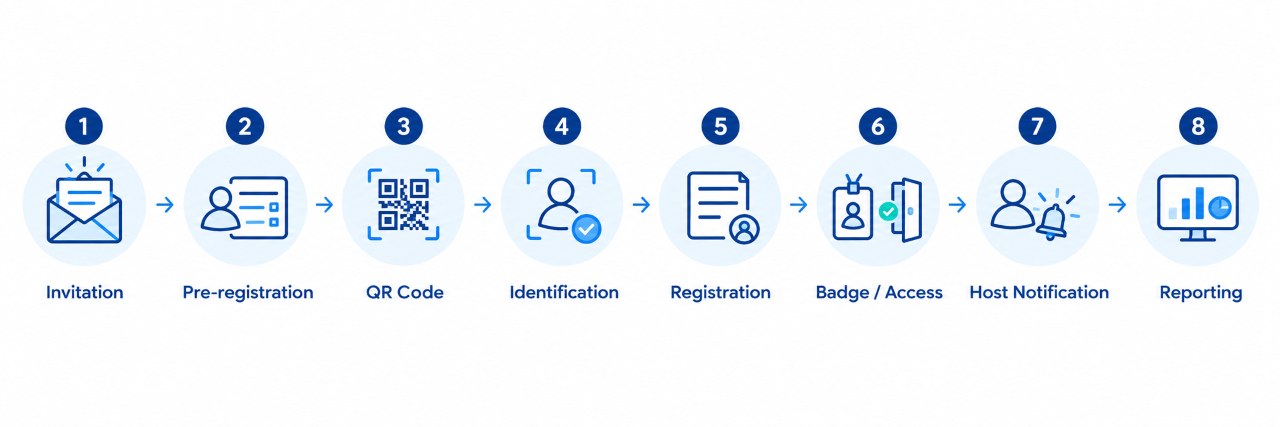
Depending on the application, Teleportel can integrate with existing access control systems, Microsoft environments, identity management solutions, Wi-Fi, databases, badge printers and other IT systems.
This is particularly important for IT departments: the reception application should not become a technology island alongside the existing infrastructure.
A Modular Architecture
The reception process of an airport, hospital or logistics centre cannot simply be copied and applied to a corporate headquarters.
Teleportel therefore works with a modular Reception Suite.
Since its foundation, 54 specialised modules have been developed and can be combined according to the specific business requirements.
The building blocks cover both software and hardware, including registration, pre-registration, notifications, reporting, live video, AI, QR scanners, ID and passport scanners, document scanners, RFID, badge printing, door control and kiosks.
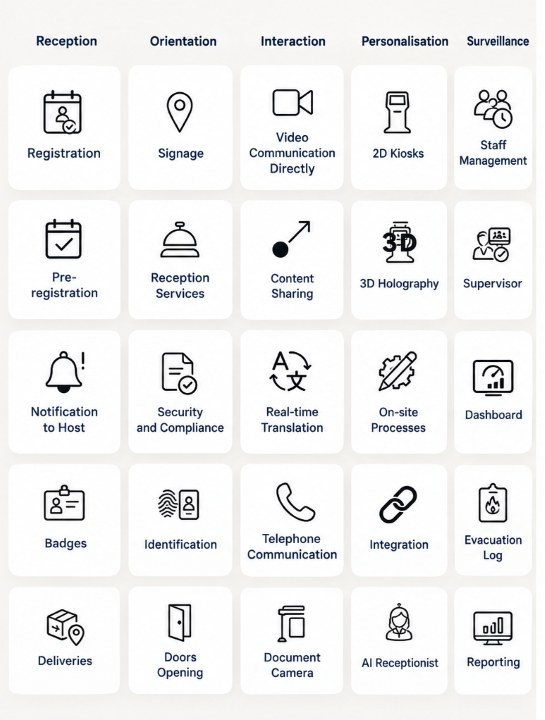
This allows organisations to start with the processes they actually need, rather than adapting their way of working to a single standard software package.
Applications Across Different Sectors
Corporate & Multi-Tenant Buildings
Corporate headquarters, multi-tenant buildings and flexible office spaces can combine digital check-in with centralised reception services.
Logistics & Industry
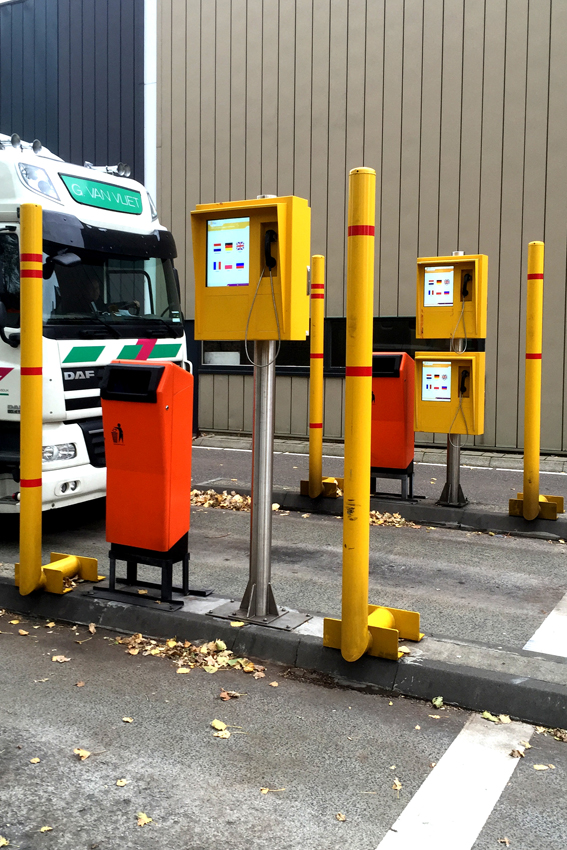
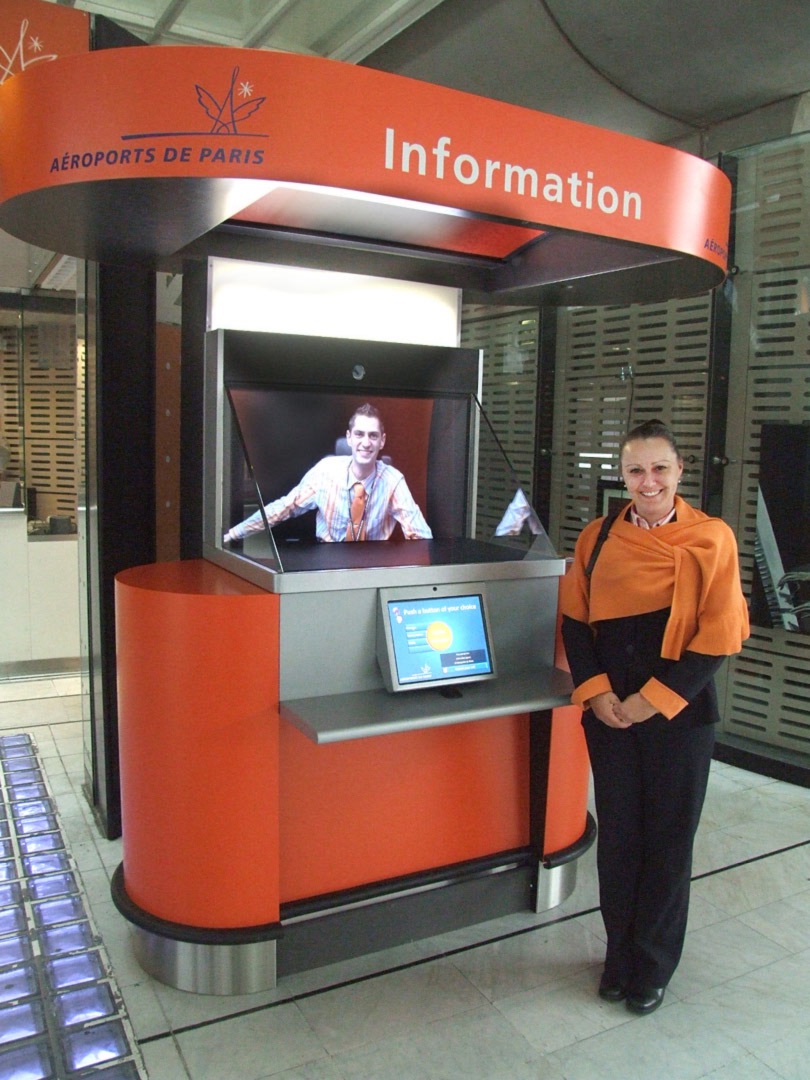
A reception kiosk for truck drivers can register drivers, display safety information, process documents and enable communication with remote staff.
Public Sector
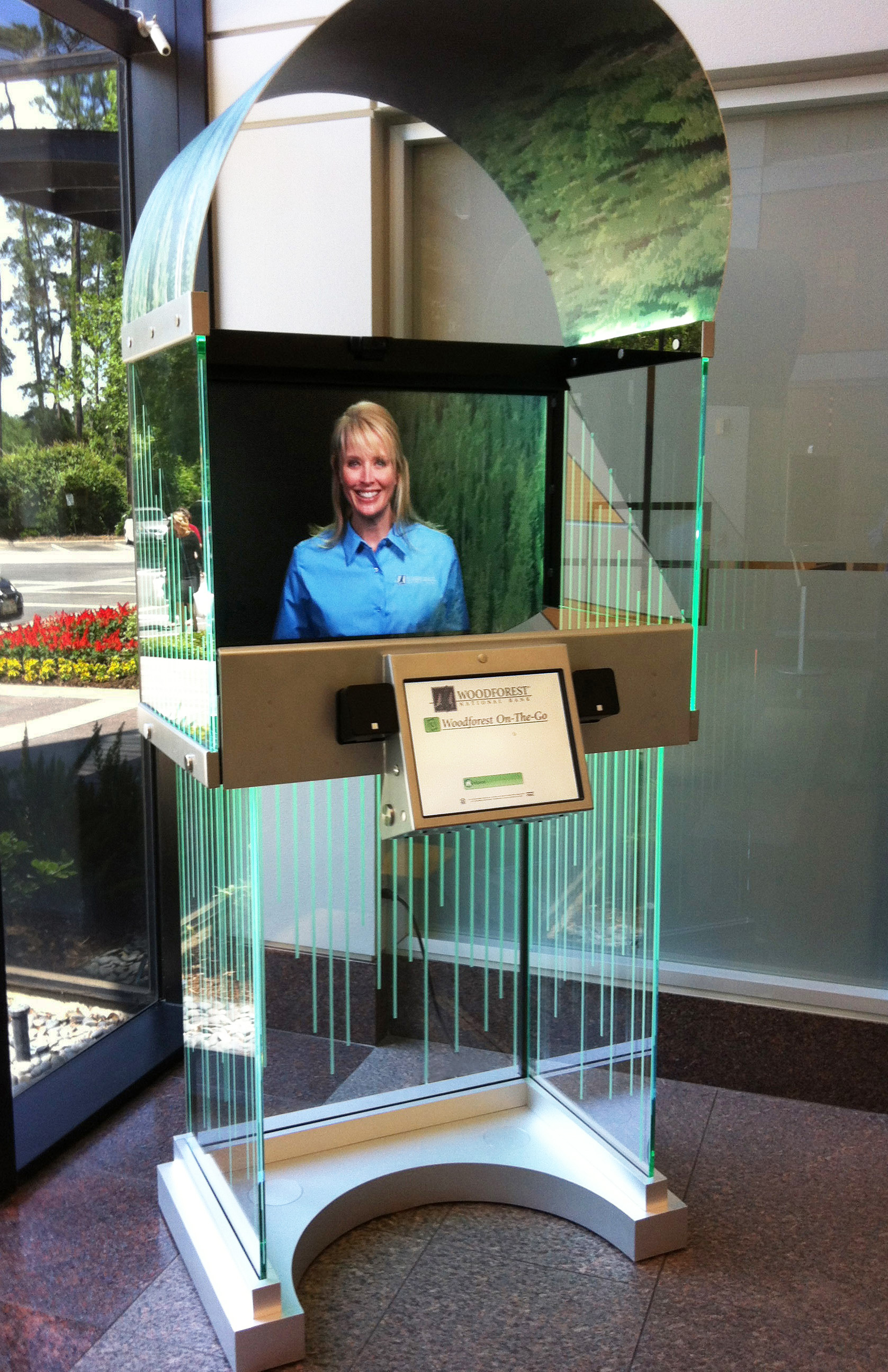
A digital reception kiosk can handle visitor registration and provide information while keeping an agent available remotely for situations requiring individual assistance.
Healthcare
Check-in processes can be used for patients, visitors or suppliers, depending on specific organisational and regulatory requirements.
Service Points
A physical kiosk can provide access to a remote agent in situations where maintaining a permanent on-site presence is difficult to justify operationally.
Hotels & Self-Storage
Sites spread across multiple locations can also benefit from centralised services and remotely managed access workflows.
Security and Privacy Must Be Considered from the Start
A paper visitor logbook may seem simple, but it contains personal data and offers limited options for controlled data retention, reporting or access management.
A digital system provides more possibilities, but it also imposes higher requirements for IT security and privacy.
For European applications, Teleportel positions its architecture around European data hosting, GDPR compliance and data sovereignty.
Live video communication and visitor data should therefore be included in the same security assessment as identity management and physical access control.
AI Is Transforming Reception, but It Does Not Replace Every Interaction
AI makes it possible to automate an increasing number of standard questions and visitor journeys.
However, this does not mean that every reception process needs to become fully autonomous.
A practical hybrid architecture uses different levels of service:
- Digital self-service for predictable transactions,
- AI for information, guidance and dynamic interactions,
- Human assistance for exceptions, complex questions and situations where personal contact adds genuine value.
This is probably more important than deciding whether a reception is “staffed” or “unstaffed”.
Modern reception can be both.
Reception as Part of Facility Management, Operations, IT and Security
Reception is physically located at the entrance to an organisation, but technologically it sits at the intersection of several disciplines.
Facilities Management focuses on services and buildings.
Operations focuses on processes and workforce management.
IT focuses on system integration, management and cybersecurity.
Security focuses on identity and access.
HR and Workplace Management focus on employees and the visitor experience.
An intelligent reception platform connects these different areas.
The digital transformation of reception is therefore less about the kiosk itself and more about how an organisation structures its physical reception as an integrated business process.
About Teleportel
Teleportel was founded in Brussels in 2001 and develops solutions for Digital Reception, Virtual Reception and Reception over Distance.
Its technology combines digital visitor registration, visitor management software, AI, secure live video communication, kiosks and integrations with existing IT and access control systems.
The guiding principle:
Automated when possible. Human when needed.
Discover how the Teleportel Intelligent Reception Platform seamlessly combines digital and human reception to deliver an efficient, secure and future-ready visitor experience.